

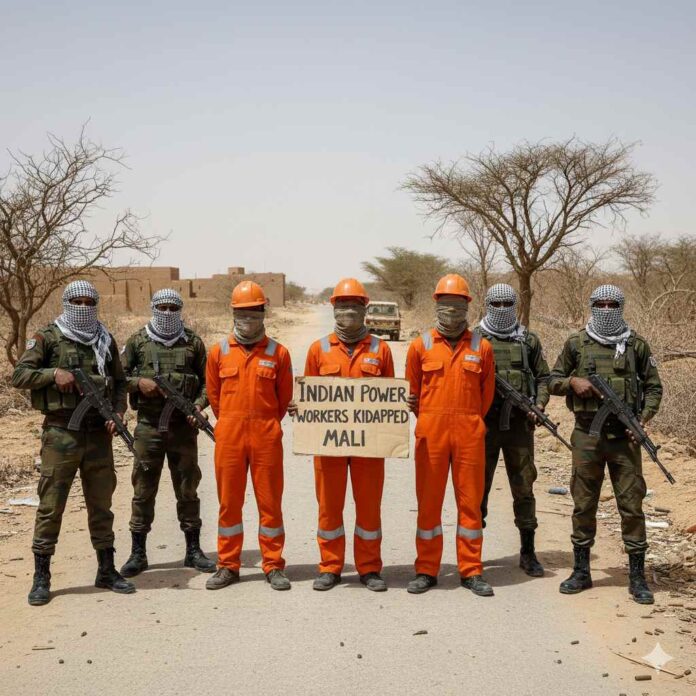
BAMAKO, MALI – The escalating security crisis in Mali has claimed a distressing new target: five Indian nationals working on a critical electrification project in the country’s restive western region.
Their abduction on Thursday near Kobri by unidentified gunmen has cast a stark light on the immense personal risk borne by foreign workers spearheading vital infrastructure development in West Africa’s most unstable zones.
The kidnapped individuals were employees of a company tasked with extending Mali’s power grid—a project central to the nation’s economic recovery and the daily lives of its citizens.
The very effort designed to literally bring light to remote communities has been violently overshadowed by the darkness of mounting jihadist activity.
A representative for the contracting company confirmed the kidnapping, noting that all other Indian personnel have been swiftly evacuated to the capital, Bamako, as a precautionary measure.
A Recurring, Profitable Crisis While no group has yet claimed responsibility, security analysts point to the region’s prominent terrorist organizations, namely the Al-Qaeda-linked Group for the Support of Islam and Muslims (JNIM) and local affiliates of the Islamic State (ISIS), both of which have made the kidnapping of foreigners a lucrative source of financing.
The incident is the latest in a troubling pattern. Just last week, three foreign nationals—two Emiratis and an Iranian—were released for a reported ransom of over $50 million after being held by JNIM fighters near Bamako since September. This successful high-value ransom payment raises the fear that the kidnapping of the Indian workers will be viewed by militant groups as a low-risk, high-reward strategy.
Development vs. Instability
The abduction highlights the precarious balance for nations like India, which is actively engaged in infrastructure development across the African continent.
Indian professionals often work in challenging and under-served areas, yet their commitment to building roads, railways, and power grids now places them directly in the crosshairs of geopolitical and internal conflicts.
Mali, governed by a military junta since a series of coups, has seen a sharp deterioration in its security situation following the break in defense ties with Western allies like France and the US. This instability has been compounded by a devastating economic crisis, worsened by a crippling fuel blockade enforced by JNIM.
The kidnapping is not just a humanitarian crisis for the families of the five men; it is a serious setback for international development efforts in the Sahel region, signalling that the conflict has deepened its reach from military targets to the very projects meant to stabilize the nation.
The Indian Embassy in Bamako is reportedly coordinating with Malian security forces and company officials to ensure the safe and swift release of the hostages. The incident serves as a harsh reminder that in the battle against extremism, even the most fundamental work of development is fraught with peril.
[Newsroom staff written original, where key claims or facts are used, I’ve referenced the original sources (like The New Indian Express, The Times of India, Hindustan Times, MEA, etc.) transparently.]