

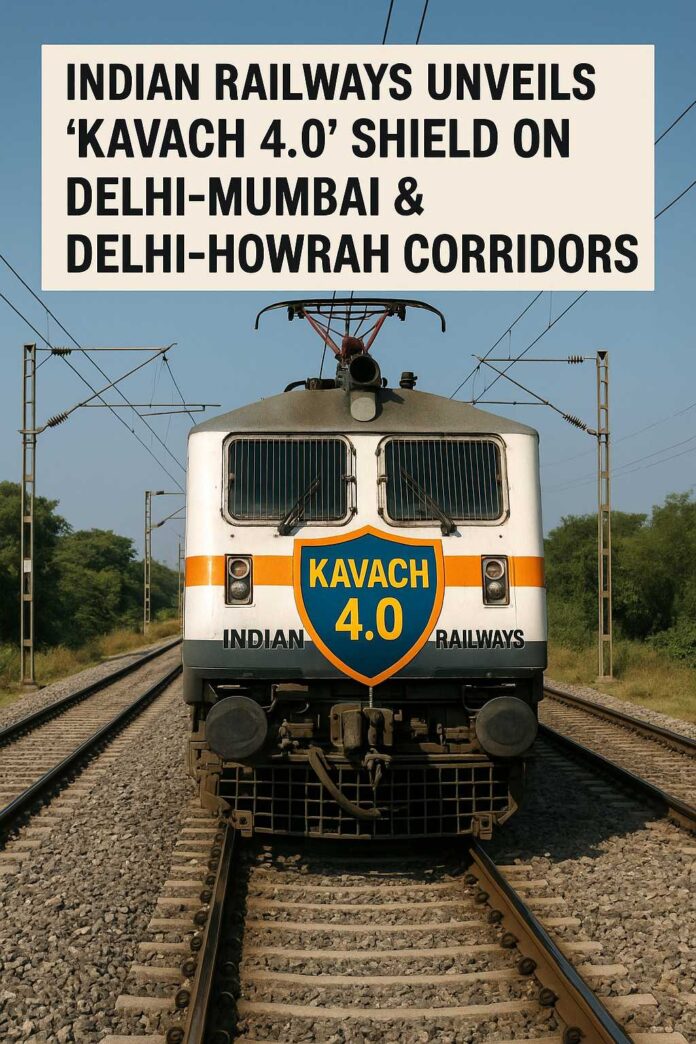
Indian Railways has achieved a monumental safety milestone by commissioning Kavach 4.0, the upgraded version of its indigenously developed Automatic Train Protection (ATP) system, on critical sections of the Delhi–Mumbai and Delhi–Howrah corridors. This deployment places a high-tech safety shield on two of India’s busiest and most vital rail arteries, dramatically reducing the risk of collisions and human error.
The move marks a significant leap in the national transporter’s modernization efforts, directly enhancing passenger safety and operational efficiency on these high-density routes.
What is Kavach 4.0?
The New Standard for
Rail Safety
Kavach (Hindi for ‘Shield’) is a sophisticated, electronic system designed by the Research Designs and Standards Organisation (RDSO). It has been adopted as India’s national ATP system and is certified to Safety Integrity Level-4 (SIL-4), the highest global standard for railway safety mechanisms, meaning its probability of failure is extremely low.
The newly commissioned Kavach 4.0 includes several key technological upgrades over its predecessor, Version 3.2:
- Higher Location Accuracy: Ensures train positions are tracked with greater precision, crucial for safe braking maneuvers.
- Improved Yard Signal Information: Provides clearer, more reliable data about signal aspects in large, complex railway yards.
- OFC-Based Station Interface: Utilizes Optical Fibre Cable (OFC) for more reliable, high-speed, station-to-station communication.
- Direct Integration with Electronic Interlocking : Allows seamless connection with existing electronic signaling systems, enhancing overall system reliability. How Kavach Works to Prevent Accidents
The system functions as a vigilant digital co-pilot, automatically applying brakes and preventing critical human errors that lead to accidents.
Key Commissioned Sections (Kavach 4.0)
The commissioning of the advanced Kavach 4.0 version has focused on the busiest stretches, which are now fully operational with the ATP system:
Delhi–Mumbai Corridor:
Section: Palwal–Mathura–Nagda stretch.
Coverage: 633 Rkm commissioned.
Delhi–Howrah Corridor:
Section: Howrah–Bardhaman section (Eastern Railway).
Coverage: 105 Rkm commissioned.
Mathura-Kota Section (West Central Railway):
Coverage: 324 Rkm commissioned in July 2025, the first section to be cleared by an Independent Safety Assessor (ISA) for version 4.0.
Kota-Nagda Section (West Central Railway):
Coverage: 225 Rkm commissioned, completing the Mathura-Nagda stretch.
Work in Progress & Future Zones
While the above sections are commissioned, extensive work is progressing across multiple zones to meet the target of covering 15,512 Rkm of the high-density network.
South Central Railway (SCR): This zone played a pioneering role, having successfully deployed and trialed the previous Kavach 3.2 on 1,465 Rkm. SCR is now actively working on upgrading this existing coverage to Version 4.0 and adding new sections.
East Central Railway (ECR): The ECR has received approval for a large-scale ₹1,822 Crore project to install Kavach on several key routes, including the DDU-Patna-Jhajha mainline, covering approximately 2,200 km within the zone’s jurisdiction.
Central Railway (CR): Central Railway has reportedly become the first zone to award contracts to cover its entire network with the Kavach system, with work expected to be completed in the next two to three years.
New Bids & Capacity: Bids have been invited for equipping another 9,069 locomotives with Kavach 4.0, indicating a massive acceleration in the pace of rolling stock integration.
The government has prioritized the system’s rapid deployment, aiming to complete nationwide coverage of the entire network by 2030, significantly faster than the initial estimates.