

Image Source content.api.news
Aomori, Japan – December 9, 2025
The silence of a late Monday night in Aomori Prefecture was violently shattered at 11:15 PM local time. Not with a crash, but with a visceral, gut-wrenching tremor. A powerful Magnitude 7.6 earthquake, centered 80 kilometers off the coast, slammed into the heart of Japan’s northern Honshu region, immediately launching the entire northeast coast into a desperate midnight vigil against the threat of a tsunami.
While Japan’s sophisticated seismic monitoring systems performed flawlessly, the true story of this latest natural challenge is one of preparedness meeting panic in the darkness.
The Ground That Wouldn’t Hold
In Hachinohe, the nearest major city to the quake’s epicenter, the JMA registered an upper 6 on the Shindo intensity scale—a level where staying upright is near impossible. Eyewitnesses described a chilling, sustained vibration that seemed to tear through the very foundation of their lives.
“It wasn’t a sudden jolt, it was a long, violent, sickening churn,” recounted Satoshi Kato, a high school vice-principal in Hachinohe, who helped turn his school into an emergency evacuation shelter. “The dishes were flung from shelves, and my car began shaking so violently I thought the tires would explode. But the minute the shaking stopped, it was the sound of the siren that took over, reminding us of the second, greater danger.”
The Evacuation in the Dark
The immediate tsunami warning, cautioning of potential waves up to 3 meters (10 feet) for coastal prefectures like Hokkaido, Aomori, and Iwate, triggered a mass evacuation of over 90,000 residents. In the dead of night, the evacuation process became a fraught maze of traffic jams, fear, and split-second decisions.
The sight of cars clogging highways, all heading inland or to designated high ground, underscored the lingering trauma of the 2011 disaster. For many coastal residents, the tsunami warning is not an advisory, but a memory.
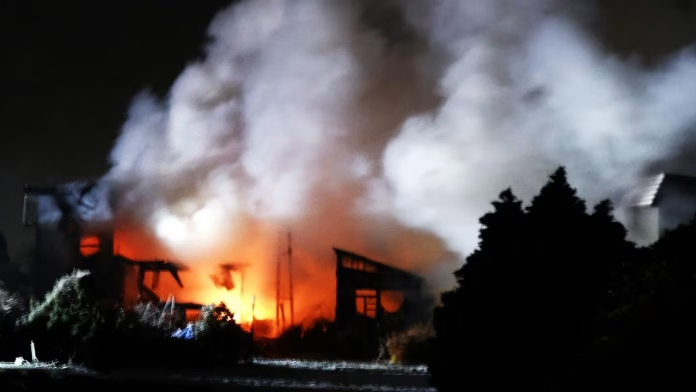
Initial waves, thankfully, came in lower than the feared 3-meter maximum—with a peak of 70cm (28 inches) recorded at Kuji Port in Iwate. Yet, the fear was tragically realized in smaller incidents: reports of several fires in Aomori City, shattered glass, and more than 30 minor injuries, including a man whose car fell into a crack that opened in a Tohoku road.
The Nuclear Echo
A key point of relief in the early hours was the safety check of the region’s nuclear power plants. Tohoku Electric Power and Hokkaido Electric Power confirmed that all facilities, including those in the area, reported no abnormalities or irregularities, a crucial reassurance following the 2011 Fukushima Daiichi catastrophe.
As dawn breaks over the Pacific, the immediate danger has passed, and tsunami warnings have been downgraded. However, the Japanese Meteorological Agency (JMA) has issued a sobering advisory, warning of an elevated probability of a future, even more powerful “megaquake” in the coming days.
For the survivors in Aomori and the wider Sanriku coast, the long, anxious night is over, but the quiet, relentless work of damage assessment and the psychological toll of another close call is just beginning. Japan’s constant confrontation with the volatile ‘Ring of Fire’ ensures that life remains a delicate balance between unparalleled preparation and existential threat.
Government Response and Initial Damage Assessment
The Japanese government moved swiftly, underscoring the nation’s high state of disaster preparedness.
Immediate Action
- Emergency Task Force: Prime Minister Sanae Takaichi immediately announced the formation of an Emergency Task Force to coordinate the response, stating, “We are putting people’s lives first and doing everything we can.”
- Evacuation Orders: Chief Cabinet Secretary Minoru Kihara urged all residents in areas under the tsunami warning—specifically Hokkaido, Aomori, and Iwate Prefectures—to “immediately head to higher ground or take shelter.” More than 90,000 residents were advised to evacuate.
- Mobilization: The Self-Defense Forces (SDF) were immediately mobilized. Defence Minister Shinjiro Koizumi confirmed that 18 defense helicopters were deployed for an urgent damage assessment survey across the affected northern coast.
- Nuclear Safety: Safety checks were a top priority. Authorities confirmed that nuclear power plants in the region, including the decommissioned Fukushima Daiichi plant, reported no abnormalities or irregularities. A minor spill of about 450 liters of water occurred at the Rokkasho fuel reprocessing plant in Aomori, but officials stated the water level remained normal and posed no safety concern.
Preliminary Damage and Casualties
The initial reports indicate that while the shaking was severe (reaching an upper 6 on the Shindo scale), the prompt warnings likely limited severe injuries:
- Injuries: At least 32 people were reported injured across Aomori, Hokkaido, and Iwate prefectures, primarily from falling debris and objects. One man was injured when his car fell into a hole that opened on a road in Tohoku.
- Infrastructure: Approximately 2,700 homes in Aomori Prefecture initially lost electricity. There were scattered reports of fires, and initial ground surveys began at dawn to assess damage to coastal ports and municipal buildings.
- Evacuees: Around 480 residents spent the night taking shelter at the Hachinohe Air Base and other designated evacuation centers.
Travel Disruptions and Aftershock Concerns
The earthquake severely impacted air and rail travel across the northern regions.
Shinkansen and Rail
- Bullet Train Suspension: The Tōhoku Shinkansen (Bullet Train) services were immediately suspended between Shin-Aomori Station and Fukushima Station for track inspection. This left one Shinkansen carrying 94 passengers stranded overnight in Aomori.
- Local Lines: East Japan Railway suspended operations on several local lines throughout the night, with track inspections continuing into the morning.
Air Travel
- Airport Stranding: Roughly 200 passengers were stranded overnight at New Chitose Airport in Hokkaido as flights were halted or diverted following the quake and tsunami warning.
Aftershock Risk
The Japan Meteorological Agency (JMA) issued a serious follow-up advisory, warning of an increased probability of a stronger earthquake (potentially magnitude 8-level) and subsequent tsunami hitting the Sanriku and Hokkaido coasts in the coming days. This fear of a ‘megaquake’ is what is prompting local authorities to urge communities to maintain a high level of alert for the remainder of the week.