

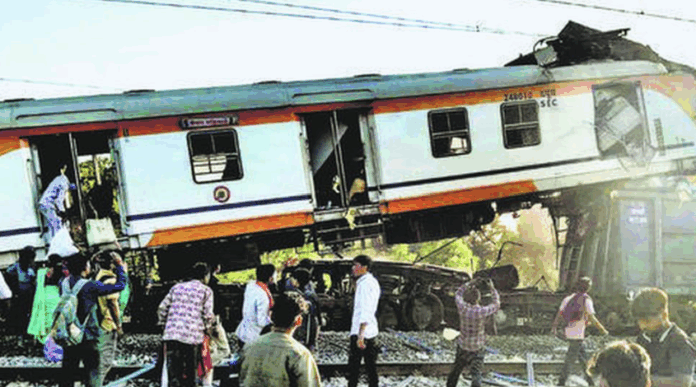
Image Source thehindu
BILASPUR, CHHATTISGARH —A horrifying collision just outside Bilaspur on Tuesday afternoon tragically cut short the journey of a local passenger train, leaving at least 11 people dead and over 20 severely injured. The routine commute from the coal belt of Gevra to Bilaspur Junction turned into a scene of mangled metal and human crisis when the Mainline Electric Multiple Unit (MEMU) passenger train rear-ended a stationary cargo rake with devastating force.
The preliminary cause of the accident, which occurred around 4:00 PM, points starkly to human error and a critical signal breach.
The Moment of Impact: An ‘Overshot Red’
Eyewitness accounts and initial assessments by the South East Central Railway (SECR) suggest the passenger train, reportedly traveling at an estimated 60-70 kmph, ran past a red signal positioned to protect the stationary freight train ahead.
The violence of the collision was catastrophic. One passenger coach of the MEMU train, the front portion of which is occupied by the engine and pilot, was violently forced to mount the last wagon of the heavy goods train. This severe ‘telescoping’ effect caused the maximum fatalities and injuries, trapping passengers in a crushing embrace of steel and debris.
“Before I could understand what happened, people started screaming and shouting for help,” recounted a survivor who was in one of the first few coaches. The impact was described as a thunderous sound, followed by the shattering of windows and instant darkness.
The Loco Pilot of the passenger train, identified as Vidya Sagar, was tragically among the deceased. His female Assistant Loco Pilot, Rashmi Raj, sustained critical injuries and is currently receiving treatment. The fact that a veteran railway employee—the one responsible for safety—was the first casualty highlights the abruptness and force of the crash.
Rescue Operations and The Long Wait
Rescue teams, including personnel from the Railways and local district administration, mobilized rapidly. However, the unique and difficult position of the wreckage—a passenger coach perched on top of a goods wagon—complicated efforts. Specialized equipment, including iron cutters, had to be deployed to painstakingly slice through the twisted metal and extricate survivors and bodies.
For hours, the track near Lal Khand, between Gatora and Bilaspur stations, was a hub of intense activity. Officials confirmed that an infant was among those safely rescued, offering a small moment of relief in the grim operation.
The injured, many suffering from severe trauma and fractures, have been shifted to the Chhattisgarh Institute of Medical Sciences (CIMS) and local private hospitals in Bilaspur.
Accountability and Compensation
While human error is the preliminary focus, a detailed, high-level inquiry has been ordered by the Commissioner of Railway Safety (CRS). This investigation will seek to definitively determine the exact sequence of events, scrutinize the signaling system’s logs, and identify any systemic failures that may have contributed to the catastrophe.
The Railways have announced an ex-gratia compensation package:
- ₹10 lakh for the families of the deceased.
- ₹5 lakh for the critically injured.
- ₹1 lakh for those with minor injuries.
This tragedy serves as a grim and forceful reminder of the continuous, critical importance of safety protocols in one of the world’s largest railway networks. For the families of the victims, their routine journey has ended in an irreversible loss, with the wait for answers just beginning.
[Newsroom staff written original, where key claims or facts are used, I’ve referenced the original sources (like The Times of India, ANI etc.) transparently.]